
.png)
.png)
.png)
Selecting the correct motor for an electric fire pump is one of the most critical decisions in designing a reliable fire protection system. An undersized motor can fail during emergency operation, while an oversized or improperly specified motor can lead to unnecessary cost, electrical complications, and compliance issues. For fire pump manufacturers, consultants, contractors, and project owners, understanding motor selection is essential to ensure both performance and code compliance.
This article provides a comprehensive guide to selecting the correct motor for electric fire pumps, covering hydraulic requirements, electrical considerations, code compliance, environmental factors, and common mistakes.
.jpg)
1. Understand the Role of the Motor in a Fire Pump System
The electric motor is the driving force behind the fire pump. In a fire emergency, the motor must start immediately and operate continuously under full-load conditions without failure. Unlike many industrial motors that operate intermittently, fire pump motors are designed for high reliability under worst-case scenarios.
Fire pump motors are governed primarily by the requirements of National Fire Protection Association through NFPA 20. These standards specify how motors must be sized, rated, and installed to ensure dependable performance during fire events.
2. Start with Pump Hydraulic Requirements
Motor selection begins with the pump, not the motor itself. The pump’s rated flow and pressure determine the required brake horsepower (BHP).
The key data required:
-
Rated flow (GPM or m³/h)
-
Rated pressure (PSI or bar)
-
Pump curve
-
Maximum load point (typically at 150% of rated flow)
NFPA 20 requires that the motor be capable of driving the pump at any point on its curve without overloading. This is especially important at 150% of rated capacity, where horsepower demand may increase significantly.
If the motor cannot handle the maximum load condition, it may trip or overheat during actual fire demand — an unacceptable risk.
3. Calculate Required Brake Horsepower (BHP)
Brake horsepower is determined from pump hydraulic performance. Manufacturers typically provide BHP values at rated flow and at 150% flow.
The motor must be selected so that:
Motor Rated Horsepower ≥ Maximum Pump BHP (at any point on curve)
In many cases, engineers add a safety margin beyond the maximum calculated BHP. However, NFPA 20 already requires motors to handle the full non-overloading portion of the curve, so oversizing must be done carefully to avoid unnecessary electrical system upgrades.
4. Follow NFPA 20 Motor Sizing Rules
NFPA 20 contains very specific motor selection requirements:
-
The motor must not overload at any point on the pump curve.
-
It must be rated for continuous duty.
-
It must have a service factor appropriate for fire pump service.
-
Locked rotor current (LRC) must be considered for power supply design.
Unlike general-purpose motors, fire pump motors are allowed to draw higher starting current because fire pumps are considered life safety equipment. The system must be designed to accommodate this.
Understanding these requirements early prevents costly redesigns later in the project.
5. Consider Voltage and Power Supply Availability
Motor voltage must match the available site power supply. Common voltages include:
-
380V / 400V / 415V (international projects)
-
460V (North America)
-
600V (Canada and industrial facilities)
Before final motor selection, confirm:
-
Utility transformer capacity
-
Available short-circuit current
-
Voltage drop during motor start
-
Generator compatibility (if applicable)
Large fire pump motors can cause significant voltage dips during starting. Engineers must verify that starting current will not negatively impact other building systems.
6. Understand Starting Methods
Electric fire pumps typically use one of the following starting methods:
-
Direct-on-line (DOL)
-
Star-delta (reduced voltage)
-
Soft starter
-
Autotransformer starter
NFPA 20 generally requires across-the-line starting unless the power utility restricts it. Reduced voltage starters may be permitted when justified.
The starting method affects:
-
Locked rotor current
-
Cable sizing
-
Generator sizing
-
Transformer selection
Motor selection and controller design must be coordinated carefully.
7. Service Factor and Temperature Rise
Fire pump motors must operate under extreme conditions. The service factor indicates how much overload a motor can tolerate under specific conditions.
A service factor of 1.15 is common for fire pump motors. However, reliance on service factor for continuous operation is not recommended. The motor should be properly sized without depending on service factor margin.
Ambient temperature must also be considered. If installed in a pump room with high temperatures, derating may be required.
8. Enclosure Type and Environmental Conditions
Motor enclosure selection depends on the installation environment.
Common enclosure types include:
-
Open Drip Proof (ODP)
-
Totally Enclosed Fan Cooled (TEFC)
-
Weather Protected Type II (WPII)
In clean indoor pump rooms, ODP motors are common and cost-effective. In humid, dusty, or outdoor environments, TEFC or WPII may be more appropriate.
Environmental conditions to evaluate:
-
Ambient temperature
-
Humidity
-
Dust or corrosive atmosphere
-
Flood risk
-
Ventilation quality
Choosing the wrong enclosure can shorten motor life significantly.
9. Horizontal vs Vertical Fire Pump Motors
Motor selection also depends on pump configuration.
Horizontal Split Case Pumps
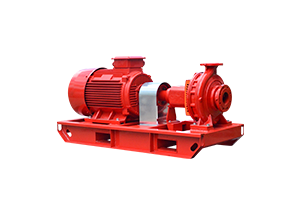
These pumps typically use horizontal motors mounted on a baseplate with flexible coupling alignment. Shaft alignment and baseplate rigidity are critical.
Vertical Turbine Fire Pumps
Vertical turbine fire pumps require hollow shaft motors when using vertical line shaft configurations. The motor must be capable of handling:
-
Thrust load from pump impellers
-
Proper shaft coupling
-
Correct hollow shaft diameter
Incorrect motor selection in vertical turbine systems can cause thrust bearing failure.
10. UL and Certification Requirements
In many international projects, especially in North America and the Middle East, fire pumps and motors must be certified.
Certification bodies include:
-
UL Solutions
-
FM Approvals
A UL listed fire pump system requires compatible listed motors and controllers. Using a non-listed motor in a listed system can invalidate approvals.
Manufacturers must ensure that the entire fire pump package — pump, motor, controller — is compliant as a system.
11. Locked Rotor Current (LRC) and Electrical Design
One of the most overlooked aspects of motor selection is locked rotor current.
LRC can be 6–8 times the full-load current. This affects:
-
Breaker sizing
-
Cable sizing
-
Generator capacity
-
Transformer rating
Electrical engineers must verify that the upstream system can handle motor starting without nuisance tripping.
Fire pump circuits are typically dedicated and designed to prioritize operation even during voltage fluctuations.
12. Generator Compatibility
If the fire pump is backed by an emergency generator, coordination becomes even more critical.
Generator sizing must consider:
-
Motor starting kVA
-
Voltage dip limits
-
Recovery time
-
Frequency stability
An undersized generator can fail to start the motor properly, rendering the fire protection system ineffective.
Always verify motor starting characteristics against generator capabilities.
13. Common Mistakes in Fire Pump Motor Selection
-
Selecting motor based only on rated flow, ignoring 150% flow.
-
Ignoring voltage drop during start.
-
Choosing incorrect enclosure for environment.
-
Over-relying on service factor.
-
Not verifying compatibility with controller.
-
Failing to coordinate with generator supplier.
-
Using non-certified components in certified systems.
These mistakes can lead to project delays, inspection failures, and long-term reliability issues.
14. Future-Proofing Your Motor Selection
When designing large facilities such as industrial plants, data centers, or high-rise buildings, consider:
-
Potential system expansion
-
Power supply upgrades
-
Redundancy requirements
-
Long-term maintenance accessibility
Selecting a motor with slight forward capacity can provide flexibility, but it must remain within compliance limits.
15. Coordination Between Pump, Motor, and Controller
The most successful fire pump installations result from coordinated system design. Pump manufacturers, motor suppliers, and controller manufacturers must work together.
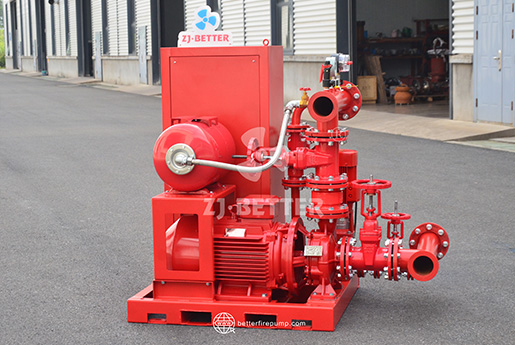
As a fire pump manufacturer, providing a fully engineered fire pump package reduces risk for contractors and consultants. Integrated design ensures:
-
Proper horsepower matching
-
Verified electrical compatibility
-
Code compliance
-
Certification consistency
This system-level approach improves reliability and simplifies approval processes.
Conclusion
Selecting the correct motor for electric fire pumps is not simply a matter of matching horsepower. It requires a detailed understanding of pump hydraulics, NFPA 20 requirements, electrical system capacity, environmental conditions, certification standards, and starting characteristics.
The motor must be capable of driving the pump at every point on its curve, especially at 150% flow, without overload. It must comply with fire protection standards, integrate with the controller, and operate reliably under emergency conditions.
For fire pump manufacturers and system designers, careful motor selection protects not only equipment investment but also lives and property. A properly engineered electric fire pump system begins with a correctly selected motor — and that decision should always be made with full technical evaluation and compliance awareness.