
.png)
.png)
.png)
How to Reduce Fire Pump Noise in Indoor Installations?
Jan 29, 2026
Share:
Fire pumps are critical life-safety components in modern buildings. They are designed to deliver reliable water pressure during fire emergencies, often operating under high power and demanding conditions. However, when fire pumps are installed indoors—especially in hospitals, hotels, residential complexes, data centers, and commercial buildings—noise and vibration can become serious concerns.
Excessive fire pump noise can affect occupant comfort, disrupt sensitive environments, damage surrounding equipment, and even lead to complaints or regulatory challenges. While noise reduction should never compromise fire protection performance, it can be effectively controlled through proper design, equipment selection, and installation practices.
This article explains why fire pumps generate noise, identifies common noise transmission paths, and provides practical, proven solutions to reduce fire pump noise in indoor installations, from the planning stage through long-term operation.
Understanding Fire Pump Noise Sources
Before applying noise control measures, it is essential to understand where fire pump noise originates. Fire pump noise typically comes from three primary sources.
Mechanical Noise
Mechanical noise is generated by rotating components such as:
-
Electric motors or diesel engines
-
Pump impellers
-
Bearings and couplings
This type of noise is usually continuous during operation and increases with pump speed, load, and wear.
Hydraulic Noise
Hydraulic noise results from:
-
High water velocity
-
Turbulence inside the pump
-
Cavitation caused by inadequate suction conditions
Poor piping design or incorrect pump selection can significantly increase hydraulic noise.
Structural Vibration Noise
Vibration from the fire pump and driver can travel through:
-
Concrete floors
-
Walls
-
Piping systems
Once vibration reaches building structures, it can re-radiate as airborne noise in adjacent rooms, sometimes far from the pump room itself.
Why Indoor Fire Pump Noise Control Matters
Indoor fire pump installations present unique challenges compared to outdoor pump houses.
-
Noise reflects and amplifies within enclosed spaces
-
Vibration easily transfers into building structures
-
Sensitive occupancies require low background noise levels
-
Retrofitting noise solutions later is often costly
Proper fire pump noise control improves:
-
Occupant comfort
-
Equipment lifespan
-
Compliance with project noise requirements
-
Overall system reliability
Noise reduction should be considered part of good fire pump system engineering, not an afterthought.
Proper Fire Pump Selection to Reduce Noise
Noise control starts with selecting the right fire pump for the application.
Choose the Correct Pump Type
Different fire pump types produce different noise levels:
-
Electric motor-driven fire pumps generally produce lower noise than diesel fire pumps
-
Vertical turbine fire pumps may transmit less vibration to the floor if properly installed
-
Oversized pumps often generate unnecessary noise due to excessive flow and pressure
Selecting a pump that closely matches system demand helps minimize hydraulic turbulence and vibration.
Avoid Overspeed and Oversizing
Oversized pumps operating far from their best efficiency point often create:
-
Increased vibration
-
Higher noise levels
-
Premature mechanical wear
Accurate hydraulic calculations and proper pump sizing significantly reduce noise issues.
Fire Pump Room Location and Layout Design
The physical location and layout of the fire pump room play a major role in noise control.
Strategic Pump Room Placement
Whenever possible:
-
Avoid placing fire pump rooms adjacent to offices, patient rooms, or residential units
-
Use buffer spaces such as stairwells, storage rooms, or mechanical rooms
-
Locate pump rooms at ground or basement levels with solid structural support
Early coordination between fire protection, architectural, and mechanical teams is critical.
Adequate Space Around Equipment
Crowded pump rooms amplify noise and vibration. Adequate clearance:
-
Reduces sound reflection
-
Allows proper maintenance
-
Prevents direct vibration contact with walls and ceilings
A well-planned layout contributes directly to noise reduction.
Vibration Isolation: The Most Critical Noise Control Measure
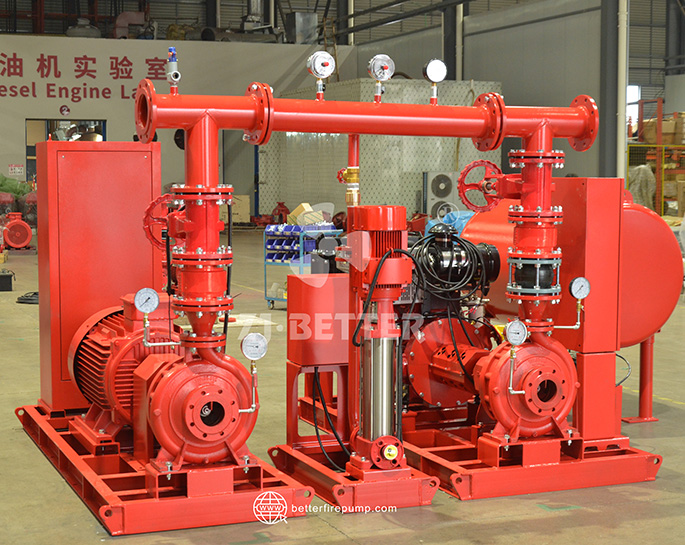
Vibration isolation is often the single most effective method for reducing fire pump noise indoors.
Use Vibration Isolators
Fire pumps should be mounted on:
-
Spring isolators
-
Rubber or neoprene pads
-
Inertia bases with vibration isolation mounts
The selection depends on pump size, speed, and building structure.
Inertia Base Installation
An inertia base:
-
Adds mass to absorb vibration
-
Reduces transmitted forces to the floor
-
Improves pump stability and alignment
Properly designed inertia bases are highly effective for large electric and diesel fire pumps.
Piping Design to Minimize Noise Transmission
Piping systems are a major path for noise and vibration transmission.
Flexible Pipe Connections
Flexible connectors should be installed:
-
At pump suction and discharge
-
Between rigid piping and pump nozzles
These connectors reduce vibration transfer without compromising system integrity.
Proper Pipe Support and Anchoring
Incorrect pipe support can amplify noise:
-
Avoid rigid connections directly to walls
-
Use vibration-isolated pipe hangers
-
Ensure correct spacing and alignment
Poor piping design often causes more noise problems than the pump itself.
Acoustic Treatment of Fire Pump Rooms
Acoustic treatment addresses airborne noise within the pump room.
Sound-Absorbing Materials
Applying sound-absorbing materials to:
-
Walls
-
Ceilings
-
Doors
helps reduce echo and reverberation inside the room.
These treatments do not affect fire pump performance and can significantly lower perceived noise levels outside the pump room.
Fire-Rated Acoustic Solutions
All acoustic treatments must comply with:
-
Fire resistance requirements
-
Local building and fire codes
Fire-rated acoustic panels and enclosures are widely available for fire pump rooms.
Enclosures and Barriers for Noise Control
In high-noise applications, additional measures may be required.
Partial or Full Pump Enclosures
Acoustic enclosures around:
-
Diesel engines
-
High-power electric motors
can reduce airborne noise significantly while allowing proper ventilation and access.
Engine Exhaust Noise Control
For diesel fire pumps:
-
Exhaust silencers can reduce exhaust noise
-
Proper routing prevents noise transmission to occupied areas
Exhaust systems should be designed without increasing back pressure.
Electrical and Control Equipment Noise Considerations
Fire pump controllers and auxiliary equipment can also contribute to noise.
-
Transformers may generate humming sounds
-
Poorly mounted panels can vibrate
-
Loose components increase rattling noise
Secure mounting and proper spacing help prevent unnecessary noise.
Maintenance and Long-Term Noise Reduction
Noise often increases over time due to wear and poor maintenance.
Regular Inspection and Alignment
Misalignment of:
-
Pump and motor
-
Couplings
-
Bearings
can dramatically increase vibration and noise.
Monitor for Cavitation and Wear
Signs of cavitation or internal wear include:
-
Unusual noise
-
Increased vibration
-
Reduced performance
Early detection prevents both noise issues and system failure.
Balancing Noise Control and Fire Safety Compliance
Noise reduction measures must never compromise fire protection performance.
-
Fire pump flow and pressure requirements must remain unchanged
-
Access for inspection and testing must be maintained
-
All modifications must comply with applicable fire codes and standards
A qualified fire pump manufacturer or fire protection engineer should be involved in any noise control strategy.
.jpg)
Conclusion
Reducing fire pump noise in indoor installations requires a comprehensive approach that combines proper pump selection, thoughtful room design, vibration isolation, piping engineering, acoustic treatment, and ongoing maintenance.
When noise control is addressed early in the design phase, it is easier, more effective, and more cost-efficient. For existing installations, targeted upgrades such as vibration isolators, flexible piping, and acoustic treatments can significantly improve conditions without affecting fire safety.
As fire pump manufacturers, we strongly recommend considering noise and vibration control as an integral part of indoor fire pump system design—ensuring reliable fire protection while maintaining a safe and comfortable indoor environment.