
.png)
.png)
.png)
What Is Fire Pump Static Water Level?
Aug 27, 2026
Share:
In a fire protection system, the water supply is just as important as the fire pump itself. A properly selected fire pump cannot perform reliably if the available water supply does not provide sufficient volume, pressure, or suction conditions.
One important factor in evaluating a fire pump installation is the static water level.
So, what is fire pump static water level?
The fire pump static water level generally refers to the elevation of the water surface in the supply source when the fire pump is not drawing water. Depending on the system design, the water source may be a storage tank, suction tank, reservoir, well, or other approved water supply.
For fire pump applications, the relationship between the static water level and the elevation of the pump suction is particularly important. It helps determine whether the pump receives adequate suction pressure and whether the water supply arrangement can support reliable fire protection operation.
A change in water level can significantly affect the hydraulic conditions at the pump inlet. For this reason, engineers, contractors, inspectors, and facility owners should consider water level conditions when selecting, installing, commissioning, and maintaining fire pumps.
.jpg)
Why Is Static Water Level Important for a Fire Pump?
A fire pump is designed to deliver a specified flow rate at a specified pressure. However, the pump does not operate independently of its water source.
The suction conditions at the pump inlet influence the overall performance of the system.
When the water source is located above the fire pump, the elevation difference between the water surface and the pump suction can create positive pressure at the pump inlet. When the water level drops, that pressure decreases.
For example, imagine a fire pump supplied by a storage tank. When the tank is full, the water surface may be several meters above the pump suction flange. As water is consumed, the water level falls. The static pressure created by the water column also decreases.
This means the pump may experience different suction conditions at different water levels.
This is particularly important when evaluating the lowest water level, rather than only the normal or full-tank condition. A system that appears to have excellent suction conditions when the tank is full may have significantly different conditions when the tank approaches its minimum operating level.
NFPA 20 provisions related to fire pump water supplies recognize the importance of water elevation and suction conditions. For example, NFPA committee material has emphasized the relationship between the water level remaining after the required fire flow duration and the elevation of the fire pump.
Static Water Level vs. Pump Suction Pressure
Static water level and suction pressure are related, but they are not the same thing.
Static water level describes the elevation of the water surface.
Suction pressure describes the pressure available at the pump suction under a particular operating condition.
The difference is important because water level is only one factor affecting suction pressure.
For a tank supplying a fire pump, the elevation difference between the water surface and the pump suction contributes to the pressure available at the pump inlet. As the water surface rises, the available static head generally increases. As the water surface falls, the available static head decreases.
A simplified relationship can be expressed as:
Static head = Water surface elevation − Pump suction elevation
For water, the corresponding pressure can be approximated from the height of the water column.
In practical fire pump engineering, however, the complete suction condition must also consider friction losses, fittings, valves, piping configuration, and the operating flow rate.
Therefore, static water level should not be treated as a substitute for a complete hydraulic calculation.
Static Water Level and Fire Pump Suction Conditions
The suction side of a fire pump deserves particular attention because inadequate suction conditions can affect pump performance and reliability.
When a pump operates, water flows from the supply source through the suction piping and into the pump. This creates flow-related losses. As the flow increases, friction losses in the suction piping generally increase.
Therefore, there is an important difference between:
- Water level when the pump is idle
- Water level while the pump is operating
- Suction pressure at zero flow
- Suction pressure at rated flow
- Suction conditions at maximum expected flow
A static measurement alone cannot describe every operating condition.
For example, a tank may have a satisfactory static water level, but the pump could still experience unfavorable suction conditions if the suction piping is poorly designed, the piping is undersized, or excessive restrictions are present.
This is why fire pump design should evaluate the complete water supply and suction arrangement rather than relying on a single static measurement.
Static Water Level in Fire Pump Storage Tanks
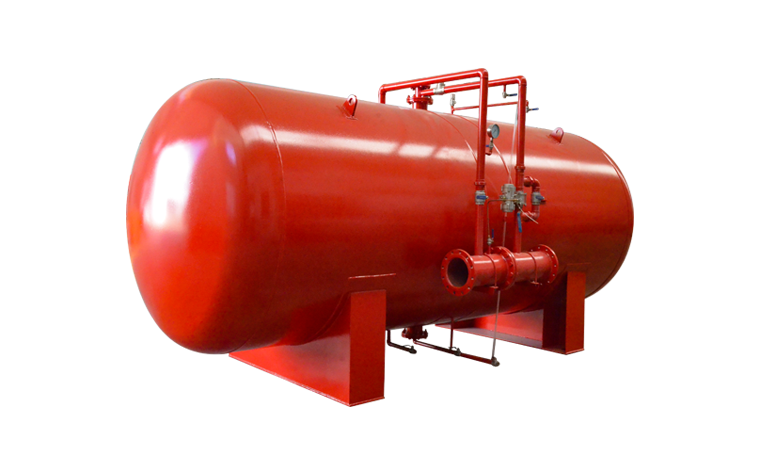
Storage tanks are one of the most common water sources for fire pumps.
A fire protection tank may have several important water levels, including:
- Maximum water level
- Normal operating water level
- Alarm water level
- Minimum usable water level
- Water level remaining after the required fire duration
From a fire pump perspective, the minimum relevant water level can be especially important.
During a fire, sprinklers, hose stations, standpipes, or other fire protection equipment may consume water continuously. As water leaves the tank, the water surface drops.
The fire pump must continue receiving an adequate water supply under the expected operating conditions.
Consequently, engineers need to understand not only the tank capacity but also the elevation of the water surface relative to the pump suction.
A large tank does not automatically guarantee good fire pump suction conditions. The geometry, tank elevation, outlet arrangement, suction piping, and minimum operating water level all need to be considered.
What Happens When the Static Water Level Is Too Low?
If the water level becomes too low, several problems can develop.
First, the available static head decreases. This reduces the pressure available at the pump suction.
Second, the pump may have to operate under a more demanding suction condition. If the available suction pressure becomes insufficient, the pump may not achieve the expected hydraulic performance.
Third, poor suction conditions can contribute to cavitation risk.
Cavitation occurs when local pressure in the pump falls sufficiently low for vapor bubbles to form and subsequently collapse as pressure increases. This can cause noise, vibration, loss of performance, and potentially damage pump components.
The exact risk depends on the pump design and operating conditions, so engineers should evaluate the available net positive suction head and the pump's requirements rather than using static water level alone.
This is one reason water supply conditions must be considered carefully during fire pump selection and system design.
Static Water Level and NPSH
Net Positive Suction Head, commonly abbreviated as NPSH, is another important concept when discussing pump suction conditions.
NPSH relates to the pressure available at the pump suction relative to the vapor pressure of the liquid.
Two commonly discussed terms are:
- NPSH available (NPSHA)
- NPSH required (NPSHR)
NPSHA is determined by the actual system and water supply conditions. NPSHR is associated with the pump's hydraulic design and operating point.
The available NPSH should be sufficient for the pump to operate properly under the intended conditions.
Static water level can have a direct influence on NPSHA. A higher water level generally provides more static head, while a lower water level reduces it.
However, NPSHA also depends on atmospheric pressure, water temperature, friction losses, pump elevation, and other system characteristics.
For this reason, a fire pump manufacturer should receive accurate information about the water source and suction conditions when selecting a pump.
Static Water Level and Different Fire Pump Arrangements
The importance of static water level can vary depending on the type of fire pump installation.
For an end suction or horizontal split case fire pump supplied from an elevated tank, the elevation difference between the tank water surface and pump suction can provide positive suction pressure.
For a fire pump supplied from a ground-level or underground tank, the suction arrangement may be different and requires careful hydraulic evaluation.
For vertical turbine fire pumps, water level considerations can be particularly important because the pump draws water from a source such as a well, reservoir, or tank. Water level detection and operating water levels may be evaluated as part of determining whether the pump is operating within its design conditions. NFPA 20 committee material specifically discusses water-level detection for vertical turbine pumps installed in wells.
Each arrangement therefore requires evaluation based on its actual hydraulic configuration.
Static Water Level During Fire Pump Testing
Static water level can also be relevant during fire pump testing.
A fire pump performance test evaluates whether the pump can provide the required flow and pressure under the available water supply conditions.
During testing, the water supply should be capable of supporting the required operating conditions. If the water source cannot provide sufficient flow, the test results may not represent the pump's full performance capability.
NFPA 20 acceptance-testing provisions evaluate fire pump performance at specified flow conditions, while NFPA 25 addresses inspection, testing, and maintenance of water-based fire protection systems. NFPA material also emphasizes that the water supply should be considered when evaluating fire pump test results.
For this reason, testing personnel should record relevant suction and water supply conditions rather than evaluating discharge pressure alone.
How Should Static Water Level Be Measured?
The measurement method depends on the type of water source.
For a storage tank, the water level can generally be determined using a level indicator, level sensor, calibrated tank gauge, or other approved measurement method.
For a reservoir, the water surface elevation may be determined using the reservoir's level measurement system.
For wells and similar sources, water-level measurement may require specialized equipment and consideration of both static and operating water levels.
The measurement should be referenced to a clearly defined elevation, such as the pump suction centerline or another appropriate engineering datum.
This is important because saying that a tank has "3 meters of water" does not necessarily provide enough information to evaluate the pump.
Engineers need to know where the water surface is relative to the pump suction elevation.
Static Water Level vs. Dynamic Water Level
Another common source of confusion is the difference between static and dynamic water level.
Static water level is measured when the water source is not being drawn down by the pump.
Dynamic water level is the water level while water is being withdrawn at a particular flow rate.
The dynamic level may be lower than the static level because the water supply is being consumed or because the source experiences drawdown.
This distinction can be particularly important for wells and some natural water sources.
For fire pump applications, the operating condition that matters is not necessarily the water level when everything is idle. The system must remain capable of supplying the required fire protection demand under the applicable design conditions.
Common Mistakes When Evaluating Fire Pump Water Level
Several mistakes can lead to an inaccurate assessment of fire pump suction conditions.
1. Looking only at the maximum tank level
A full tank provides favorable conditions in many systems, but it may not represent the most demanding operating condition.
The minimum operating water level should also be evaluated.
2. Treating water level and pressure as the same thing
Water level is an elevation measurement. Suction pressure is an operating measurement.
They are related but should not be used interchangeably.
3. Ignoring suction piping losses
Even with an adequate water level, excessive suction piping losses can reduce the pressure available at the pump.
4. Evaluating only static conditions
The pump must operate while water is flowing. Dynamic conditions can be significantly different from static conditions.
5. Selecting a pump before confirming the water supply
Fire pump selection should be based on the complete system requirements, including flow, pressure, suction conditions, water source, and applicable standards.
How Fire Pump Manufacturers Use Static Water Level Information
For a fire pump manufacturer, accurate water supply information is essential when selecting and configuring a fire pump package.
Typical project information may include:
- Required fire pump flow
- Required discharge pressure
- Water source type
- Maximum water level
- Minimum water level
- Pump suction elevation
- Suction pipe size and length
- Available suction pressure
- Required operating duration
- Ambient conditions
- Applicable fire protection standards
- Required certification or listing
This information allows the manufacturer and system designer to evaluate the pump's expected operating conditions more accurately.
For listed fire pumps, project requirements may also include specific installation and testing criteria. NFPA 20 is widely used as a key reference for stationary fire pump installations, while NFPA 25 addresses inspection, testing, and maintenance of water-based fire protection systems.
Why Static Water Level Matters for Fire Safety
Fire protection systems are designed to operate when they are needed most: during an emergency.
At that moment, the fire pump must receive enough water and deliver the required pressure and flow to the fire protection system.
Static water level is therefore more than a simple tank measurement. It is one part of understanding the relationship between the water source and the fire pump.
A reliable fire pump system requires the water supply, suction piping, pump, driver, controller, and downstream fire protection system to work together as an integrated system.
The water level must remain sufficient under the design conditions, while the suction arrangement must provide appropriate hydraulic conditions for the selected pump.
.jpg)
Final Thoughts
Understanding fire pump static water level is essential for engineers, fire protection contractors, pump manufacturers, facility managers, and other professionals responsible for reliable fire protection systems.
In simple terms, static water level describes the elevation of the water surface when the supply is not being actively drawn down. Its relationship to the fire pump suction elevation affects the static head and contributes to the suction conditions available to the pump.
However, static water level should never be considered in isolation.
The complete evaluation should consider minimum water level, dynamic operating conditions, suction piping losses, suction pressure, NPSH, required fire flow, tank capacity, and applicable fire protection requirements.
For fire pump projects, providing accurate water supply and elevation information at the design stage can help prevent incorrect pump selection and improve the reliability of the finished system.
As a fire pump manufacturer, BETTER Technology Group focuses on the development and manufacturing of fire pump solutions designed for demanding fire protection applications. Proper understanding of water supply conditions is an important part of selecting the right pump and building a dependable fire protection system.
Next: