
.png)
.png)
.png)
How to Reduce Fire Pump Failure During Emergency Demand?
Jan 30, 2026
Share:
Fire pumps are the heart of any fire protection system. When a fire breaks out, every sprinkler, hydrant, and hose valve depends on the fire pump to deliver adequate pressure and flow. Unlike many mechanical systems, fire pumps do not operate daily under full load. Their most critical moment is often the first and only time they are truly needed: during an emergency.
Unfortunately, real-world fire investigations repeatedly show that fire pump failure during emergency demand is not rare. In many cases, the pump itself is not defective. Failure is usually the result of design errors, inadequate maintenance, improper installation, unreliable power supply, or human factors.
Reducing fire pump failure is not about a single solution. It requires a systematic approach that begins at design and continues through manufacturing, installation, testing, and long-term operation. This article explores the most common causes of fire pump failure and practical strategies to ensure fire pumps perform reliably when lives and property are at stake.
Understanding What “Fire Pump Failure” Really Means
Fire pump failure does not always mean a complete mechanical breakdown. In emergency situations, failure may include:
-
The pump does not start automatically
-
The pump starts but cannot reach rated pressure
-
Insufficient flow at required demand points
-
Excessive vibration leading to shutdown
-
Power supply loss or engine malfunction
-
Control system failure or improper sequencing
From a fire safety perspective, any of these conditions can be catastrophic. Reducing failure means ensuring the fire pump delivers its rated performance continuously throughout the fire event.
Start with Proper Fire Pump System Design
Many emergency failures originate long before the pump is ever installed. Poor system design is one of the leading contributors to fire pump underperformance.
Hydraulic calculations must be accurate and conservative. Undersized pumps, incorrectly selected impellers, or unrealistic pressure assumptions can cause the system to fall short during peak demand. Fire pump selection should always consider worst-case scenarios, including multiple sprinklers operating simultaneously, hose stream allowance, elevation losses, and friction losses.
Equally important is proper suction design. Inadequate water supply, excessive suction lift, or insufficient net positive suction head can cause cavitation, vibration, and flow instability. A fire pump cannot perform reliably if it is starved of water.
System designers must also consider future expansion. A pump sized only for today’s demand may become insufficient as buildings are modified or expanded. Designing with a reasonable margin reduces the risk of failure years later.
Choose Reliable Fire Pump Equipment and Components
Not all fire pumps are created equal. Manufacturing quality, material selection, and compliance with recognized standards play a major role in long-term reliability.
Fire pumps should be designed and manufactured in accordance with applicable fire protection standards, with verified performance testing. Components such as shafts, bearings, mechanical seals, wear rings, and casings must withstand long periods of inactivity followed by immediate full-load operation.
Controllers are another critical element. Many failures occur not in the pump itself, but in the control system. Reliable controllers should provide accurate sensing, dependable automatic starting, and clear alarms without unnecessary complexity.
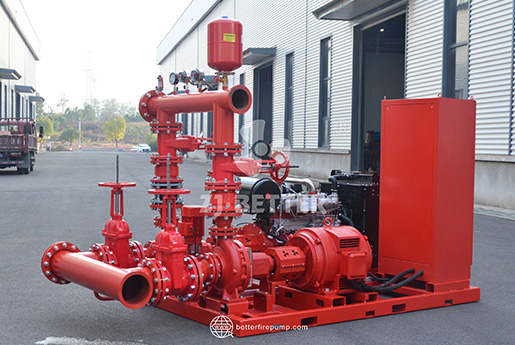
For diesel engine fire pumps, engine quality is especially important. Cooling systems, fuel delivery, starting batteries, and engine controls must be designed specifically for emergency fire service, not adapted from general industrial engines.
Ensure Correct Installation and Alignment
Even the best fire pump can fail if installed incorrectly. Misalignment, improper piping, or inadequate foundations often lead to vibration, seal failure, and bearing damage.
Fire pump foundations must be rigid and level, capable of supporting both static and dynamic loads. Grouting should be properly executed to prevent movement over time. Pump and driver alignment must be verified after installation and rechecked after initial operation.
Suction and discharge piping should be independently supported. The pump should not carry the weight or stress of connected piping. Improper piping loads can distort pump casings and reduce hydraulic performance.
Valves, strainers, and fittings must be installed according to manufacturer recommendations. Improper valve orientation or partially closed valves are surprisingly common causes of reduced flow during emergencies.
Address Power Supply Reliability
A fire pump is only as reliable as its power source. Loss of power during a fire is a frequent and predictable event, making power supply planning essential.
For electric fire pumps, power reliability must be carefully evaluated. Dedicated feeders, protected routing, and coordination with emergency power systems are critical. Voltage drop under starting conditions should be analyzed to ensure the motor can reach full speed quickly.
Diesel engine fire pumps offer independence from utility power, but they introduce their own risks. Fuel quality, fuel storage, ventilation, exhaust systems, and cooling water supply must be properly managed. Starting batteries should be maintained and tested regularly, as battery failure is one of the most common causes of diesel fire pump failure.
In many facilities, redundant fire pump arrangements or backup power strategies can significantly reduce the risk of total system failure.
Implement a Robust Testing and Maintenance Program
Fire pumps are emergency devices, not everyday machines. This makes regular testing and maintenance absolutely essential.
Weekly or monthly churn tests verify that the pump starts automatically and operates smoothly. These tests help identify issues such as starting delays, abnormal noise, vibration, or control malfunctions before an emergency occurs.
Annual flow testing is equally important. It confirms that the pump can deliver its rated performance at various flow points. Over time, wear, corrosion, or changes in the system can reduce capacity without obvious warning.
Maintenance activities should include lubrication, seal inspection, coupling alignment checks, controller inspection, and verification of alarm functions. For diesel pumps, fuel system inspection, cooling system checks, and battery testing are especially critical.
Maintenance should never be reactive. Waiting for a failure to occur defeats the purpose of a fire pump.
Train Personnel and Reduce Human Error
Human factors play a significant role in fire pump failure. In many incidents, pumps failed simply because someone turned off a valve, disabled a controller, or misunderstood an alarm.
Facility personnel should be trained to understand the basic function of the fire pump system, including what should and should not be adjusted. Clear signage and lockable valves can help prevent accidental interference.
Emergency procedures should be documented and practiced. Operators should know how to respond to alarms, how to verify pump operation, and when to contact qualified service providers.
Regular drills and inspections reinforce awareness and reduce the likelihood of mistakes during high-stress situations.
Monitor Conditions and Detect Problems Early
Modern fire pump systems increasingly incorporate condition monitoring. While fire pumps must remain simple and robust, basic monitoring can provide valuable early warnings.
Parameters such as pressure, voltage, engine temperature, battery condition, and run time can reveal developing issues long before a failure occurs. Abnormal trends should trigger investigation, not be ignored as nuisance alarms.
However, monitoring should support maintenance decisions, not replace physical inspections and testing. Technology is most effective when combined with sound operational practices.
Plan for Long-Term Reliability, Not Just Code Compliance
Meeting minimum code requirements is necessary, but it should not be the end goal. True fire safety demands a long-term view of system reliability.
Fire pump systems should be periodically reviewed as facilities age and operational conditions change. Equipment that was adequate ten or twenty years ago may no longer meet today’s risk profile.
Upgrading controllers, replacing aging engines, improving power supply arrangements, or adding redundancy can significantly reduce failure risk over the life of a facility.
Fire pumps are an investment in safety. Their value is realized only when they perform flawlessly during an emergency.
.jpg)
Conclusion
Reducing fire pump failure during emergency demand requires more than selecting a pump and hoping for the best. It is the result of thoughtful design, high-quality manufacturing, correct installation, reliable power supply, disciplined maintenance, and informed human operation.
Most fire pump failures are preventable. By addressing risks proactively and treating the fire pump system as a critical life safety asset, owners and engineers can dramatically improve reliability when it matters most.
When a fire occurs, there is no second chance for a fire pump to perform. Preparation, discipline, and attention to detail are what ensure the system delivers water, pressure, and protection exactly when it is needed.