
.png)
.png)
.png)
How to Choose the Right Fire Pump for Your Project
Sep 07, 2026
Share:
Choosing the right fire pump is one of the most important decisions when designing or upgrading a fire protection system. A correctly selected fire pump must provide the required flow and pressure under the conditions defined by the project while working reliably with the rest of the fire protection system.
Selecting a pump based only on flow rate, motor power, or price can result in an unsuitable system. The pump must be evaluated together with the building, water supply, piping network, fire protection equipment, driver, applicable standards, and actual operating conditions.
For engineers, contractors, consultants, and building owners, understanding the key factors behind fire pump selection can help reduce installation problems, improve system reliability, and ensure that the fire protection system performs as intended when it is needed.
.jpg)
1. Determine the Required Flow Rate
The first step in fire pump selection is determining the required water flow.
Fire protection systems may supply different types of equipment, including sprinklers, hydrants, hose stations, standpipes, deluge systems, or other specialized fire protection equipment. The required flow depends on the design of the complete system and the applicable project requirements.
The fire pump should be selected based on the required system demand rather than simply choosing the largest available pump.
For example, a warehouse with high-hazard storage may have very different water demand from an office building. Similarly, a high-rise building may require a substantially different pump arrangement because water must be delivered to elevated floors while maintaining sufficient pressure.
The required flow is normally expressed in gallons per minute or cubic meters per hour. Before selecting the pump, obtain the hydraulic design demand from the fire protection system design.
2. Calculate the Required Pressure
Flow alone is not enough to select a fire pump. The pump must also generate sufficient pressure to overcome the resistance of the fire protection system and provide the required pressure at the most hydraulically demanding point.
Pump pressure requirements can be affected by several factors, including:
- Building height
- Elevation differences
- Pipe friction losses
- Fittings and valves
- Sprinkler requirements
- Hose and hydrant requirements
- Equipment pressure requirements
- Water source pressure
- Special fire protection equipment
Static elevation is particularly important in high-rise applications. As the elevation increases, additional pressure is required to deliver water to the upper floors.
A proper hydraulic calculation should therefore be completed before finalizing the fire pump. The pump's rated pressure should correspond to the actual system requirements rather than being selected simply because a particular pressure rating is commonly available.
3. Understand the Pump Duty Point
The duty point is one of the most important pieces of information when selecting a fire pump.
In simple terms, the duty point represents the required combination of flow and pressure at which the fire pump is expected to operate.
For example, a project may require a fire pump to deliver a specified flow at a specified pressure. The pump performance curve should then be reviewed to confirm that the selected pump can provide the required performance.
However, the duty point should not be considered in isolation.
A fire pump may need to operate at several points depending on the project requirements. The pump curve should therefore be reviewed across the expected operating range.
Understanding the relationship between flow, pressure, efficiency, and pump performance helps prevent problems caused by selecting a pump that is too small, too large, or poorly matched to the system.
4. Consider the Water Source and Suction Conditions
The water supply is another critical factor in fire pump selection.
Before selecting the pump, determine where the fire pump will obtain its water. Possible sources include storage tanks, reservoirs, water supply networks, break tanks, or other approved water sources.
The available suction pressure and water level must be evaluated carefully.
If the pump is connected to a water source with sufficient positive suction pressure, a horizontal or vertical centrifugal fire pump may be suitable depending on the project.
When the water source is below the pump or when special suction conditions exist, additional consideration may be required. Vertical turbine fire pumps, for example, are commonly considered for applications where water must be drawn from a deep underground tank, reservoir, or other water source.
Suction conditions should also be checked to minimize the risk of cavitation and ensure stable pump operation.
5. Choose the Appropriate Fire Pump Type
Different projects require different fire pump configurations.
Common fire pump types include end-suction pumps, split-case pumps, vertical turbine pumps, and other specialized configurations.
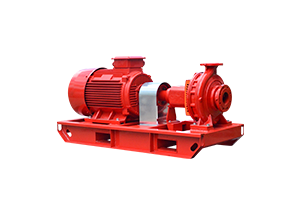
End-suction fire pumps can be suitable for many compact fire pump installations where space and system requirements allow this configuration.
Split-case fire pumps are widely used in larger fire protection systems because of their robust construction and suitability for higher flow applications. Their configuration can also provide convenient access for maintenance.
Vertical turbine fire pumps are commonly used when the water source is located below the pump installation level. They can be particularly useful for deep water tanks and reservoirs.
The correct pump type depends on the required flow, pressure, water source, installation arrangement, available space, maintenance requirements, and applicable standards.
6. Select the Right Pump Driver
The fire pump driver must be selected according to the project's electrical supply, site conditions, reliability requirements, and applicable regulations.
The two most common driver options are electric motors and diesel engines.
Electric fire pumps are widely used where a suitable and reliable electrical power supply is available. They can provide straightforward operation and are often suitable for commercial, industrial, residential, and infrastructure projects.
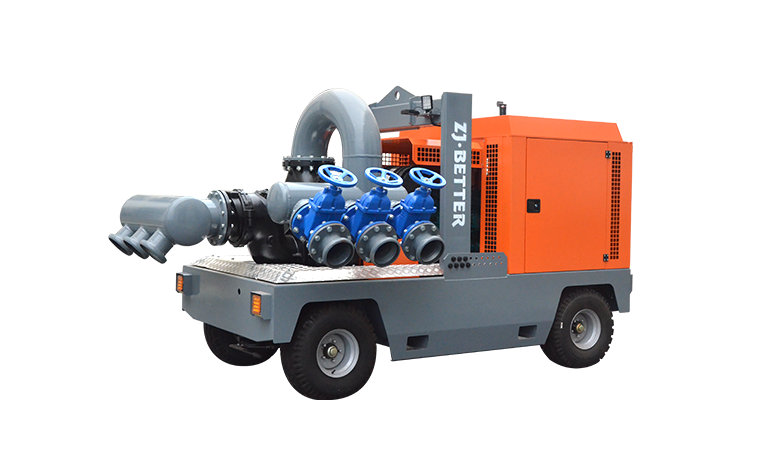
Diesel fire pumps can be considered where electrical power reliability is a concern or where the project requirements call for an independent power source. A diesel-driven fire pump system typically includes a diesel engine, fuel system, batteries, cooling system, exhaust system, and associated controls.
Some projects use both electric and diesel fire pumps to provide different sources of driving power within the overall fire protection system.
The driver should be selected together with the pump rather than treated as a separate decision. The engine or motor must have sufficient power for the selected pump across the required operating conditions.
7. Determine Whether a Jockey Pump Is Required
A jockey pump is a smaller pump used to maintain pressure in a fire protection system during normal conditions.
It is not intended to provide the main fire flow during a fire event. Instead, it helps compensate for small pressure losses and prevents the main fire pump from starting unnecessarily because of minor system pressure fluctuations.
A typical fire pump system may therefore include a main electric fire pump, a diesel fire pump, and a jockey pump, depending on the system design.
The jockey pump should be properly sized and coordinated with the main fire pumps and the pressure settings of the fire pump controllers.
Incorrect jockey pump sizing can cause unnecessary starting and stopping of the main fire pump or make it difficult for the system to respond correctly during an actual fire event.
8. Check Applicable Standards and Certification Requirements
Fire pump selection must take into account the standards and certification requirements applicable to the project.
Depending on the market and project specification, the fire pump may need to comply with requirements associated with recognized fire protection standards and certifications.
For projects requiring UL Listed equipment, the pump, motor or engine, controller, and complete fire pump assembly may need to meet specific certification requirements.
This is particularly important for international projects. A pump that appears technically suitable may not satisfy the approval requirements specified by the consultant, authority having jurisdiction, insurance company, or project owner.
Therefore, certification and approval requirements should be confirmed before purchasing or manufacturing the equipment.
9. Consider the Installation Environment
The installation environment can significantly influence fire pump selection.
Consider the available pump room space, ambient temperature, ventilation, humidity, altitude, water temperature, accessibility, and environmental conditions.
Diesel-driven systems require particular attention to ventilation, exhaust discharge, cooling, fuel storage, and maintenance access.
For projects with limited construction space or challenging site conditions, a containerized fire pump system may be considered. A containerized system can integrate the pump, driver, controller, piping, fuel system, ventilation, and other components within a prepared enclosure.
For outdoor installations or projects exposed to harsh environmental conditions, the enclosure and equipment configuration should be selected according to the actual operating environment.
10. Avoid Oversizing the Fire Pump
Selecting a larger pump may appear to provide additional safety, but oversizing can create its own problems.
A pump that is significantly larger than the actual system demand may operate away from its intended operating range. This can affect system pressure, equipment selection, installation cost, and overall system performance.
Oversizing may also require larger pipes, valves, drivers, controllers, power supplies, and other components.
The objective should not be to select the biggest pump available. The objective is to select a pump that appropriately matches the hydraulic requirements of the fire protection system.
The pump performance curve should always be reviewed against the project duty point and the relevant operating requirements.
11. Consider Maintenance and Long-Term Reliability
Fire pumps are emergency equipment, so they must remain ready for operation even when they have not been used for an extended period.
When comparing different fire pump options, consider access to components, spare parts availability, testing requirements, maintenance procedures, and technical support.
The pump room should provide adequate space for inspection and maintenance. Components such as bearings, couplings, mechanical seals where applicable, valves, controllers, batteries, and diesel engine components should be accessible for inspection and servicing.
A reliable fire pump is not simply a pump that performs well when new. It must be capable of maintaining dependable performance throughout its service life when properly installed, tested, inspected, and maintained.
12. Work With an Experienced Fire Pump Manufacturer
Fire pump selection involves more than choosing a model from a catalog.
An experienced fire pump manufacturer can help evaluate the required flow, pressure, pump type, driver, controller, certification requirements, installation conditions, and system configuration.
Before requesting a quotation, provide as much project information as possible, including:
- Required flow rate
- Required pressure
- Water source information
- Suction conditions
- Building height
- Pump room arrangement
- Electrical power supply
- Diesel fuel requirements if applicable
- Applicable standards and certifications
- Ambient and environmental conditions
- Required pump configuration
The more complete the project information, the easier it is to select a fire pump that matches the actual application.
.jpg)
Conclusion: How to Choose the Right Fire Pump
Choosing the right fire pump starts with understanding the complete fire protection system.
The key factors include required flow, pressure, duty point, water source, pump type, driver, jockey pump, certification requirements, installation environment, and long-term maintenance needs.
A properly selected fire pump should match the hydraulic requirements of the system while complying with the applicable project standards and installation conditions.
For projects ranging from commercial buildings and warehouses to industrial facilities, high-rise buildings, infrastructure projects, and specialized fire protection applications, the right pump configuration can make a significant difference in system reliability and project performance.
As a fire pump manufacturer, Better Technology Group provides fire pump solutions including electric fire pumps, diesel engine fire pumps, jockey pumps, UL fire pumps, vertical turbine fire pumps, and complete fire pump sets. By combining hydraulic design, manufacturing capabilities, testing, and project-specific technical support, a fire pump manufacturer can help engineers and contractors select equipment that is properly matched to the requirements of each project.