
.png)
.png)
.png)
How to Calculate Fire Pump Power Requirements
Nov 25, 2026
Share:
Selecting the correct power rating for a fire pump is a critical step in designing a reliable fire protection system. An undersized motor may fail to deliver the required flow and pressure, while an oversized motor can increase installation costs, energy consumption, and equipment requirements. For fire protection engineers, contractors, designers, and facility managers, understanding how to calculate fire pump power requirements is essential for making informed equipment decisions.
Fire pump power is determined primarily by the required water flow rate, total pressure or head, pump efficiency, and the characteristics of the pump and driver. Whether a system uses an electric motor or a diesel engine, accurate power calculations help ensure the pump can perform reliably under emergency conditions.
This article explains the basic formulas, calculation steps, practical examples, and key considerations for determining fire pump power requirements.
1. Understanding the Relationship Between Flow, Pressure, and Power
A fire pump converts mechanical energy into hydraulic energy to move water through a fire protection system. The amount of power required depends on how much water the pump delivers and the pressure it must generate.
Three primary factors determine the hydraulic power requirement:
Flow rate: The volume of water delivered by the pump per unit of time. It is commonly expressed in gallons per minute (GPM), cubic meters per hour (m³/h), or liters per second (L/s).
Pressure or head: The energy required to overcome elevation differences, friction losses in pipes and fittings, and the pressure needed at the discharge point.
Pump efficiency: The percentage of input mechanical power converted into useful hydraulic power. Pump efficiency varies with pump design, operating point, impeller diameter, speed, and other factors.
As flow rate or pressure increases, the power requirement generally increases. A pump delivering a large volume of water at high pressure requires a more powerful driver than a pump operating at lower flow and pressure.
Understanding these relationships is the foundation of fire pump power calculation.
2. The Basic Formula for Fire Pump Power Calculation
The most commonly used formula for calculating water pump horsepower in U.S. customary units is:
Water horsepower (WHP):
WHP = (Q × H) / 3960
Where:
-
Q = Flow rate in gallons per minute (GPM)
-
H = Total pump head in feet
-
3960 = Conversion constant
This formula calculates the hydraulic horsepower required to move water at the specified flow rate and head. However, it does not account for pump efficiency.
To determine the required pump shaft horsepower, pump efficiency must be included.
Brake horsepower (BHP):
BHP = (Q × H) / (3960 × η)
Where:
-
Q = Flow rate in GPM
-
H = Total pump head in feet
-
η = Pump efficiency expressed as a decimal
For example, a pump efficiency of 75% should be entered as 0.75.
Brake horsepower represents the mechanical power required at the pump shaft. The motor or engine must be capable of supplying at least this power under the specified operating conditions, with appropriate selection and design considerations.
3. Calculating Fire Pump Power in Metric Units
For international projects, flow rate and pressure are often specified using metric units.
The hydraulic power formula is:
Hydraulic power (kW):
P = (Q × H × ρ × g) / 1000
Where:
-
P = Hydraulic power in kilowatts
-
Q = Flow rate in cubic meters per second (m³/s)
-
H = Total head in meters
-
ρ = Water density, approximately 1,000 kg/m³
-
g = Gravitational acceleration, approximately 9.81 m/s²
When flow rate is expressed in cubic meters per hour, the formula can be simplified:
P = (Q × H × ρ × g) / 3,600,000
For water, this becomes approximately:
P (kW) = Q (m³/h) × H (m) × 0.002725
This calculates hydraulic power only.
To determine pump shaft power:
Pump shaft power (kW) = Hydraulic power / Pump efficiency
For example, if the hydraulic power requirement is 40 kW and pump efficiency is 75%:
Pump shaft power = 40 / 0.75 = 53.33 kW
The driver must be selected to meet the pump's actual power demand across its required operating range, rather than relying solely on the hydraulic power calculation.
4. Step-by-Step Example: Calculating Fire Pump Horsepower
Consider a fire protection project requiring a fire pump with the following operating conditions:
-
Rated flow: 750 GPM
-
Required pressure: 145 PSI
-
Pump efficiency: 75%
-
Water specific gravity: 1.0
Step 1: Convert pressure into total head
For water, pressure can be converted into head using:
Head (ft) = Pressure (PSI) × 2.31
Therefore:
145 × 2.31 = 334.95 ft
The pump must generate approximately 335 feet of head.
Step 2: Calculate hydraulic horsepower
WHP = (750 × 334.95) / 3960
WHP = 63.44 HP
This represents the hydraulic power transferred to the water.
Step 3: Calculate pump shaft horsepower
BHP = 63.44 / 0.75
BHP = 84.59 HP
The pump requires approximately 84.6 horsepower at this operating point.
Step 4: Select the appropriate driver
The motor or diesel engine must be capable of providing the required power under the pump's actual operating conditions. The final selection should be based on the manufacturer's performance and power curves, including the pump's power demand at higher flow rates.
A driver rated only for the calculated duty-point power may not be suitable if the pump requires greater power elsewhere on its performance curve.
5. How to Determine Total Dynamic Head (TDH)
Total dynamic head is one of the most important variables in calculating fire pump power. It represents the total energy the pump must provide to move water through the system.
TDH typically includes the following components:
Elevation difference
Water must be lifted when the discharge point is higher than the pump or water source. The elevation difference creates a static head requirement.
For high-rise buildings, elevation can significantly increase fire pump pressure requirements.
Friction losses
Water flowing through pipes experiences friction. Losses depend on pipe diameter, material, length, flow velocity, and the condition of the piping.
Additional losses occur through fittings, valves, strainers, and other system components.
Required residual pressure
The fire protection system must deliver sufficient pressure at the hydraulically most demanding location. The pump must provide enough pressure to overcome elevation and friction losses while maintaining the required residual pressure.
Available suction pressure
The water supply may provide positive pressure at the pump inlet. This available suction pressure can reduce the pressure that the pump needs to generate.
However, suction pressure must be evaluated under the required flow condition, not simply based on static supply pressure.
In practical engineering calculations, TDH is determined by evaluating the complete hydraulic system and the required operating conditions.
6. Calculating Power Using Flow Rate and Pressure
For preliminary calculations, engineers may use a pressure-based formula instead of converting pressure into feet of head.
Brake horsepower:
BHP = (Q × PSI) / (1714 × η)
Where:
-
Q = Flow rate in GPM
-
PSI = Differential pressure in PSI
-
η = Pump efficiency
-
1714 = Conversion constant
For example, consider a fire pump rated at 600 GPM and 100 PSI with a pump efficiency of 70%.
BHP = (600 × 100) / (1714 × 0.70)
BHP = 50.04 HP
The approximate shaft power required is 50 HP.
This formula is useful for preliminary estimates, but the final power requirement should be calculated using the actual differential head and the manufacturer's pump curve.
7. How Pump Efficiency Affects Power Requirements
Pump efficiency has a direct impact on the power needed to operate a fire pump.
For the same flow rate and pressure, a pump with higher efficiency requires less shaft power. A lower-efficiency pump requires more input power to deliver the same hydraulic output.
For example, consider a pump delivering 1,000 GPM at 200 feet of head.
The hydraulic horsepower is:
WHP = (1,000 × 200) / 3960
WHP = 50.51 HP
Required shaft horsepower at different pump efficiencies:
|
Pump efficiency |
Required BHP |
|---|---|
|
60% |
84.18 HP |
|
65% |
77.71 HP |
|
70% |
72.16 HP |
|
75% |
67.35 HP |
|
80% |
63.14 HP |
This example demonstrates why pump efficiency should be considered during equipment selection. Improving pump efficiency can reduce the required shaft power, although fire pump selection must always prioritize the specified fire protection performance and applicable requirements.
8. Fire Pump Power Requirements for Electric Motors
Electric fire pumps are commonly driven by electric motors. When calculating motor power requirements, it is important to distinguish between pump shaft power and electrical input power.
Pump shaft power is the mechanical power required to drive the pump. Motor electrical input power is the electrical energy consumed by the motor to produce that shaft power.
The relationship is:
Motor input power (kW) = Pump shaft power (kW) / Motor efficiency
For example, if the pump requires 60 kW of shaft power and the motor efficiency is 92%:
Motor input power = 60 / 0.92
Motor input power = 65.22 kW
The motor must provide at least 60 kW of mechanical output under the specified conditions. Electrical supply equipment must be designed to accommodate the motor's electrical requirements, including starting current, voltage, frequency, and operating conditions.
When selecting electric fire pump motors, engineers should consider:
-
Rated motor output power
-
Voltage and frequency
-
Motor speed and number of poles
-
Full-load current
-
Starting current and voltage drop
-
Motor temperature rise and insulation class
-
Ambient temperature and installation conditions
-
Compatibility with fire pump controllers
A correctly matched electric motor and fire pump controller help ensure that the complete system can start and operate reliably when required.
9. Fire Pump Power Requirements for Diesel Engines
Diesel-driven fire pumps are commonly used where reliable electrical power is unavailable, where independent backup power is required, or where the project specification calls for diesel-driven equipment.
Diesel engine selection is different from electric motor selection because engine output can be affected by environmental and operating conditions.
Important considerations include:
Engine rated power: The engine must provide sufficient mechanical power to drive the pump throughout its required operating range.
Altitude: Higher elevations reduce air density and can affect engine power output.
Ambient temperature: High temperatures can influence engine performance and cooling requirements.
Cooling system: The engine must maintain an appropriate operating temperature under continuous fire pump operation.
Fuel system: The fuel supply, tank capacity, and supporting equipment must be suitable for the specified operating duration.
Transmission and coupling: The engine and pump must be properly matched in terms of speed, torque, and mechanical compatibility.
Diesel fire pump power selection should be based on the pump manufacturer's power curve and the engine manufacturer's rated output under the applicable conditions. Any required derating should be considered before finalizing the engine model.
10. Why Rated Flow Is Not the Only Point to Check
A common mistake in fire pump power calculation is determining horsepower only at the rated flow and pressure.
A centrifugal fire pump may require more power as the flow increases. Depending on its hydraulic design, the maximum absorbed power may occur at a flow rate higher than the rated operating point.
For this reason, engineers should evaluate the complete pump performance curve, including:
-
Rated flow and rated pressure
-
Shutoff or churn condition
-
Higher-flow operating conditions
-
Pump efficiency across the operating range
-
Brake horsepower curve
-
Driver power limitations
The commonly referenced 150% rated-flow condition is particularly important in fire pump performance evaluation. The pump and driver must be evaluated according to the applicable fire pump standards, approved equipment data, and project requirements.
For example, a 1,000 GPM fire pump should not be selected based solely on the horsepower calculated at 1,000 GPM. The power demand at higher flow rates must also be reviewed to confirm that the driver is suitable.
11. Common Mistakes in Fire Pump Power Calculations
Even when the formulas are correct, inaccurate assumptions can lead to incorrect equipment selection.
Using pressure instead of total head without proper conversion
Pressure and head are related, but they are not interchangeable without considering the correct conversion and the water's specific gravity.
Ignoring pump efficiency
Calculating hydraulic horsepower alone does not determine the actual shaft power requirement. Pump efficiency must be included.
Using static suction pressure
The water supply pressure may decrease when the system is flowing. Calculations should use the available suction pressure under the relevant demand conditions.
Selecting a driver based only on the rated duty point
The pump's maximum power demand may occur at a different operating point. The complete power curve should be reviewed.
Ignoring motor efficiency
Electrical input power is greater than motor shaft output power. Electrical infrastructure calculations should account for motor efficiency and other electrical characteristics.
Overlooking site conditions
Altitude, temperature, voltage variation, fuel quality, and installation conditions may affect driver selection and system performance.
Treating horsepower calculations as final pump selection
Power calculations are only one part of the engineering process. The selected fire pump must also meet flow, pressure, suction, performance, installation, and certification requirements.
12. How to Select the Right Fire Pump Driver
After calculating the required power, the next step is to select the appropriate fire pump driver.
The selection process should include the following steps:
-
Determine the required fire protection system flow rate.
-
Calculate the required pump discharge pressure and total dynamic head.
-
Identify the suitable pump type based on the water source, installation arrangement, and system requirements.
-
Review the pump manufacturer's performance curve.
-
Calculate the required shaft horsepower or kilowatt output.
-
Check power demand across the required operating range.
-
Select an appropriate electric motor or diesel engine.
-
Verify compatibility with the fire pump controller, power supply, and installation conditions.
-
Confirm that the selected fire pump package meets applicable standards and project specifications.
Working with a fire pump manufacturer during the selection process can help engineers confirm the pump model, driver rating, operating speed, and complete package configuration before procurement.
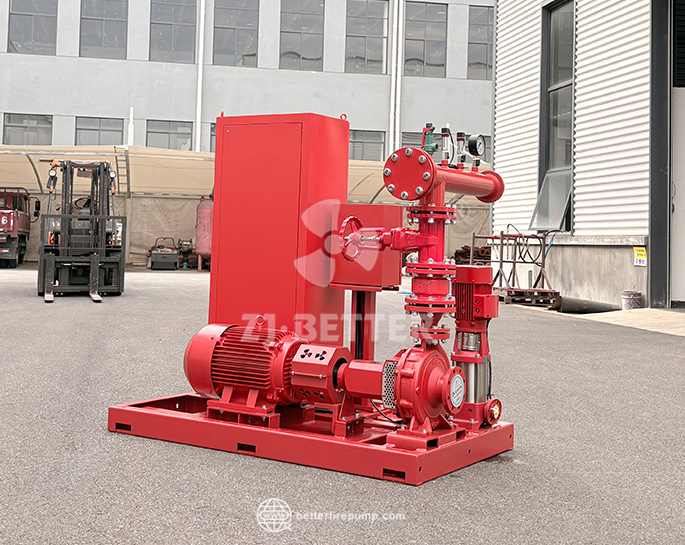
Conclusion
Calculating fire pump power requirements is essential for ensuring reliable fire protection system performance. The basic calculation depends on flow rate, total dynamic head, and pump efficiency, but the final driver selection requires a more comprehensive evaluation of the pump's operating range.
Electric motors and diesel engines have different selection considerations, and both must be matched to the actual power demand of the pump. Reviewing performance curves, system conditions, and applicable fire protection requirements is critical to avoiding undersized or unsuitable equipment.
For fire protection contractors, engineers, and project owners, choosing a correctly sized fire pump is not simply a matter of horsepower. It is about ensuring that the complete fire pump system can deliver the required water flow and pressure when it matters most.
As a fire pump manufacturer, BETTER Technology Group provides electric fire pumps, diesel engine fire pumps, jockey pumps, and customized fire pump packages designed to meet different project requirements. With proper engineering, manufacturing, and performance testing, a well-selected fire pump system helps support dependable fire protection for industrial facilities, commercial buildings, warehouses, ports, and other critical applications.